56° and Light rain shower
Image
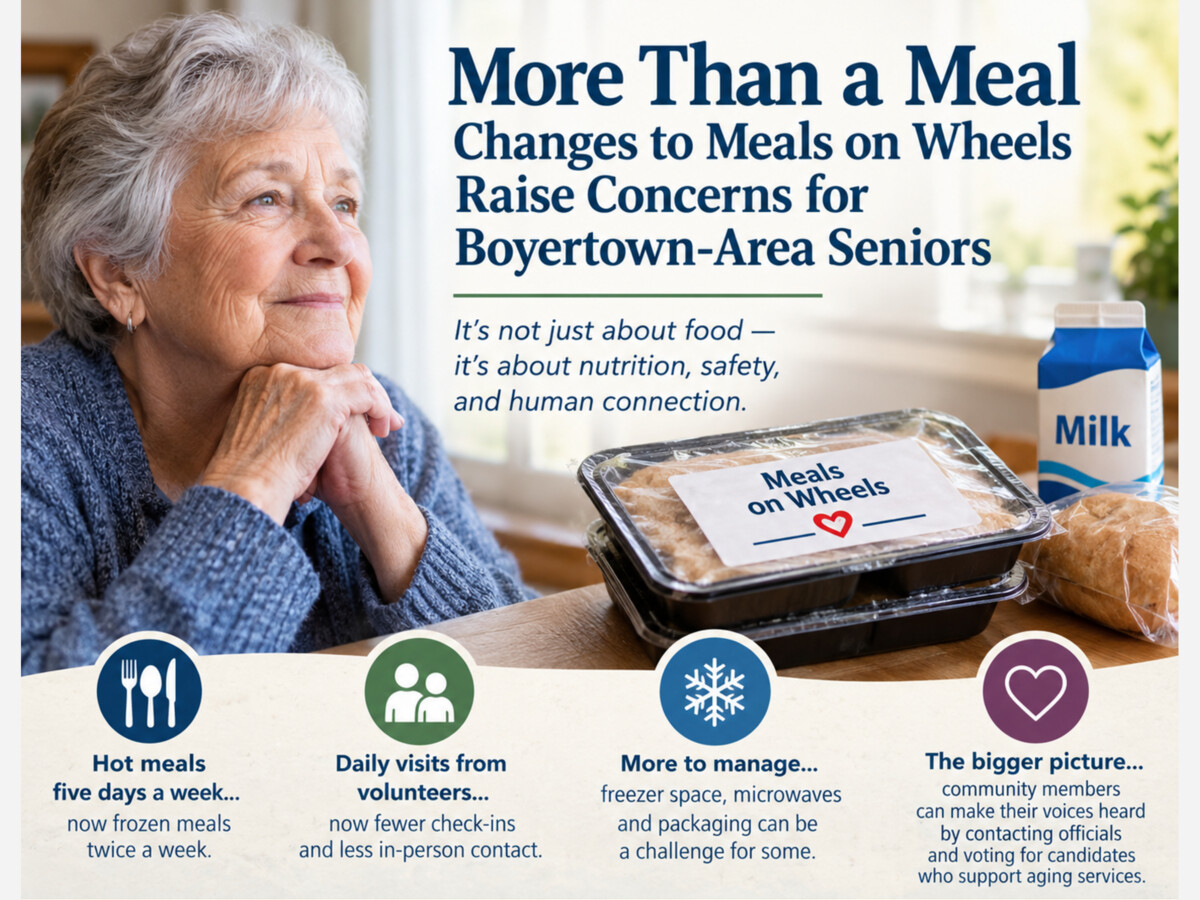



For older adults who depend on Meals on Wheels, a delivered meal can mean much more than food. It can provide reliable nutrition, a friendly face, and an opportunity for someone to notice when something is wrong.
Recent changes to the Boyertown Area Multi-Service Center’s Meals on Wheels program have altered that daily experience, raising concerns about the quality and convenience of meals and the loss of regular contact with people who may live alone.
The changes reflect decisions about how the program is funded, operated, and sustained. But for the seniors who depend on it, the consequences are personal.
For years, Boyertown Area Multi-Service prepared hot lunches in its own kitchen. Volunteers delivered the meals on weekdays, typically accompanied by bread and a beverage. Clients could also request an additional sandwich for the evening. The suggested donation was $2.50 per meal.
That arrangement offered more than a freshly prepared lunch. Volunteers saw clients regularly, sometimes developing relationships with people whose opportunities for social contact were limited.
The Berks County Area Agency on Aging (BAAA) subsequently conducted a competitive bid process to select a provider for home-delivered meals. Helping Harvest was chosen to supply the meals, replacing the locally prepared hot lunches with frozen meals.
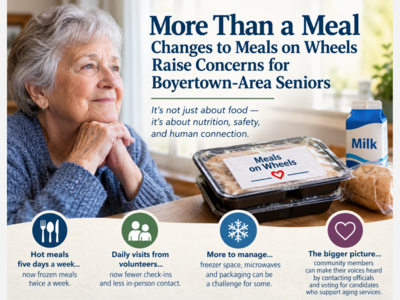
The new meals are generally delivered twice a week, with two or three meals provided at a time. Recipients must store them in a freezer and heat them in a microwave. Bread and the optional evening sandwich are no longer included. The beverage packaging has also changed, with milk supplied in larger cartons rather than smaller individual containers.
For some clients, these adjustments may be manageable. For others, they create practical difficulties. Not everyone has sufficient freezer space or a microwave, and some older adults may struggle with packaging or handling the meals. Having to heat a frozen meal can also be more challenging than receiving a hot lunch ready to eat.
The change has prompted mixed reactions. Mr. Robert Varga, Executive Director of Boyertown Area Multi-Service, who discussed the program and its transition in interviews, said some recipients have responded positively to the meals’ variety and quality, while others preferred the former hot meals. The experience underscores that a program can meet basic meal-delivery requirements without necessarily meeting every recipient’s needs in the same way.

Perhaps the most significant concern extends beyond the food itself.
Under the former arrangement, weekday deliveries gave volunteers an opportunity to see clients regularly. Those visits could provide companionship, but they also served as informal wellness checks. Volunteers were trained to report concerns about a recipient’s safety or well-being.
There have been instances in the past in which volunteers discovered someone who had fallen and remained on the floor until the delivery person arrived. A regular visit can be particularly important for someone who lives alone and may have no family member or neighbor checking in daily.
With meals now delivered only twice a week, that frequent contact has diminished. Frozen meals may be available for several days, but they do not replace the reassurance of a daily visit.
Varga acknowledged that the reduced contact is a concern. He also recognized the relationships that develop between volunteers and recipients, agreeing with the importance of those connections: “It is, and we understand that, we recognize that.”
During an initial interview he said a survey had been sent to clients and that Multi-Service was exploring a plan to increase contact and wellness checks. Such efforts could help address the gap, but they also illustrate that meal delivery and personal contact have long been intertwined.
The shift to frozen meals followed the county’s competitive bidding process. In an email responding to questions, Berks County public relations spokesman Jonathan Heintzman explained the county’s position:
“ The choice to change meal providers was made through a public bid process, which includes a structured review of all submitted bids and, in this case, meal tastings. This process is designed to be fair and equitable, ensuring that we select the provider best suited to serve the needs of older adults who qualify for the program in Berks County.
“Our primary focus remains on ensuring both the quality and long-term sustainability of the home-delivered meals program. We are committed to meeting the needs of our community and maintaining high standards for the services we provide.”
The response explains the selection process and the county’s stated priorities. It does not, however, directly address the specific concerns about the loss of daily hot meals, accompanying food items, and regular face-to-face contact.
The provider change has now been followed by another significant development: Boyertown Area Multi-Service has decided to partner with Berks Encore, a non profit senior service agency, located in Reading, that runs programs for adults 55 and older, to oversee the program’s Berks County operations. Helping Harvest continues to supply the frozen meals, and Boyertown volunteers continue delivering them. However, Berks Encore staff will coordinate routes and provide other needed management services, with an Encore staff member present in Boyertown to help manage operational issues.
Varga explained that after Multi-Service lost the meal contract, it reevaluated whether it could sustain the program in its previous form. The partnership with Berks Encore was the result of that reassessment.
A planned restoration of Friday deliveries was briefly announced to volunteers but later withdrawn following another review of the program’s financial sustainability.
Varga also pointed to the broader financial pressures affecting aging services. He believes cuts in federal, state and county funding have affected available resources, although he did not identify them as the sole reason for the changes. His comments reflect a wider reality: decisions about public funding can affect the services available to older residents in local communities.

The transition has also affected the program’s operations beyond Berks County. Montgomery County clients are expected to transition to other agencies, with county aging-services staff arranging providers. Varga said residents would not be left without services.
Meanwhile, Boyertown Area Multi-Service continues to offer hot congregate meals for older adults who can come to the center. It has also established a Grab and Go option for people age 60 and older.
Under that program, participants reserve a hot meal at least two days in advance and drive up between 11:15 and 11:45 a.m. Monday through Friday. Staff bring the meal to the car. The suggested donation is $2.50, and a $25 membership fee applies. Varga said the program was serving approximately 15 to 20 cars a day and was growing.
Grab and Go provides an alternative for some older adults, but it cannot replace home delivery for people who cannot get to the center. The availability of a different service does not eliminate the need to consider the circumstances of those who rely on Meals on Wheels.
Residents concerned about these changes do not have to remain silent. They can contact the Berks County Area Agency on Aging, county officials, and their elected representatives by mail or telephone. They can ask how decisions about meal delivery are being evaluated, what steps are being taken to preserve wellness checks, and how officials will ensure that services remain accessible to people with different physical abilities and living arrangements.
They can also make their priorities known at the ballot box by supporting candidates who take the needs of older adults and the funding of aging services seriously.
This is not about assigning blame without considering the challenges agencies face. It is about insisting that those challenges be addressed without losing sight of the people the programs exist to serve.
Older adults who depend on Meals on Wheels may have limited choices when it comes to preparing food, shopping or maintaining regular social contact. For them, a change in delivery schedules or meal preparation can have consequences that extend well beyond convenience.
Meals on Wheels is about food, but it is also about dignity, independence, and human interaction.. For some recipients, the volunteer at the door may be the only person they see that day.
A community that values its older residents should not accept the loss of those protections without asking what can be done to restore them.
Government agencies and elected officials should hear from the people they represent: The needs of older adults matter and neglecting those needs is unacceptable.


Overcast, with a high of 74 and low of 55 degrees. Patchy rain nearby for the morning, partly cloudy for the afternoon, overcast during the evening, light rain shower overnight.