63° and Clear
Image




A lonely mountain tavern, travelers who mysteriously disappeared, rumors of murder, and a deathbed confession that may or may not have happened: The ingredients sound like a Halloween ghost story. But the setting is real, and it is a familiar landmark to generations of local residents.
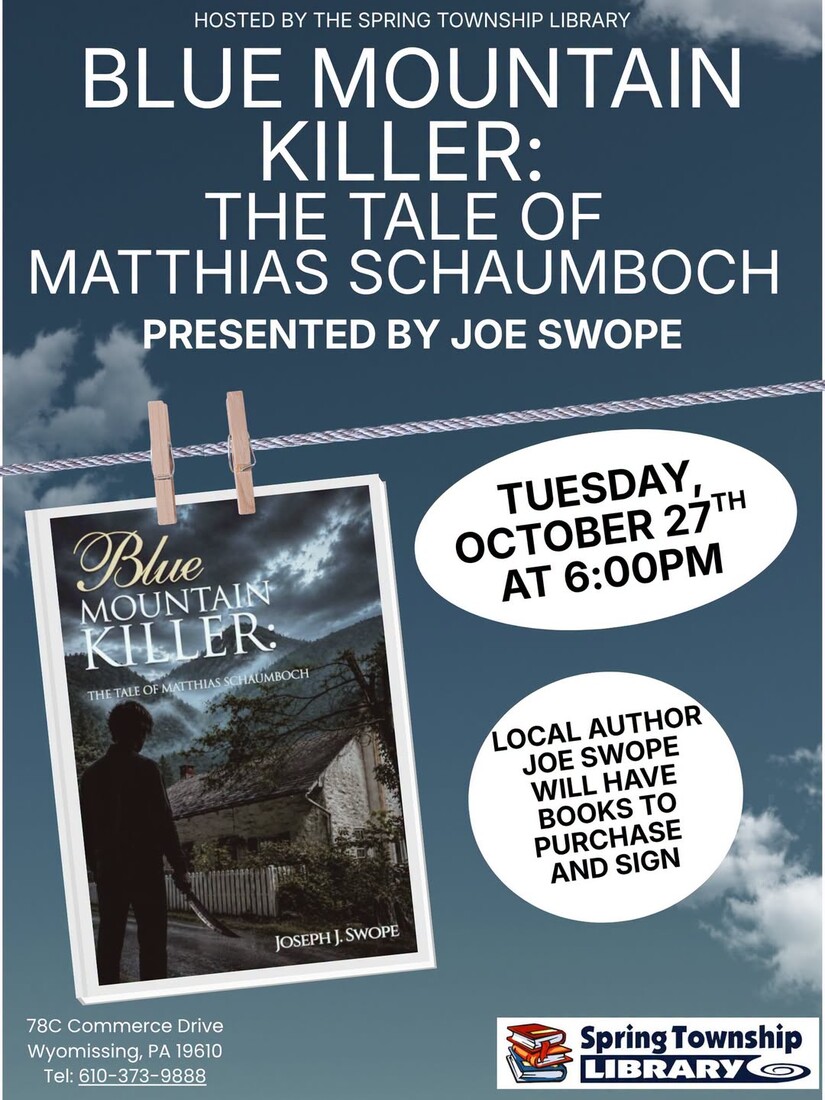
In his newly published historical novel, Blue Mountain Killer: The Tale of Matthias Schaumboch, local author Joseph Swope brings this frightening legend to life, taking readers back to the mid-19th century, when a tavern keeper on what is now Hawk Mountain allegedly developed a reputation as one of the region's most notorious killers.
The book is based on stories about Matthias Schaumboch that have circulated for generations. He operated a tavern with his wife along a mountain road traveled by merchants, farmers, and others journeying between Philadelphia, Reading, and communities farther north and west.
According to local lore, Schaumboch confessed on his deathbed to killing as many as 14 people, dismembering their bodies, and scattering their remains in the surrounding forest. The stories have grown more gruesome over time, but the historical evidence remains challenging.
The National Register of Historic Places documentation for the tavern acknowledges the longstanding murder legends while noting that no definite evidence has been found to prove them. The building itself, constructed around 1793, remains a historic structure within Hawk Mountain Sanctuary.
That uncertainty is part of what makes the story so interesting — and what attracted Swope to it.
Swope recalls he had barely finished his previous novel, Sharpened Blade: The Story of Dinah Clark, before he was back at his computer looking for his next writing project.
“One of the things I learned about writing over the years is that I can’t stop writing, because if I do, it’s nearly impossible to get started again,” he explained.
He began working on short stories and outlining another possible novel. Then, while browsing online, he encountered accounts of the alleged killer who supposedly operated out of a tavern on what is now Hawk Mountain.
Blog posts and podcasts had explored the Schaumboch legend, but the lack of physical evidence supporting the claims left plenty of room for questions — and for a novelist's imagination.
“So I found as much as I could, took a trip to Hawk Mountain to see the tavern and the landscape for myself, and started writing,” Swope said.
His research led him to a story in which the historical setting and the dark possibilities of local folklore become the foundation for a suspenseful tale. Rather than simply recounting the familiar allegations, Swope explores the psychology of a man surrounded by suspicion and the possibility that forces beyond the ordinary may be at work.
Swope is no stranger to approaching familiar stories from unexpected perspectives.
After writing Dark Age Monarch, his retelling of the King Arthur story, he wrote a prequel that presented Arthur's father, Uther Pendragon, in a less complimentary light.
For Swope, writing from the viewpoint of an antagonist offers a different kind of creative freedom.
“But when writing from the viewpoint of a serial killer, you can explore all those nasty thoughts and actions you usually have to suppress,” he said.
In Blue Mountain Killer, Matthias changes from a troubled tavern keeper into a figure whose alleged crimes, disturbing behavior, and increasingly troubling reputation create fear throughout the surrounding community.
The story builds toward confrontation as suspicion grows, but contradictory accounts and folklore complicate developing a straightforward explanation of what happened.
Swope also extends the darkness beyond Matthias's lifetime, suggesting that whatever evil may have lived on the mountain, did not necessarily disappear with him.
The result combines historical fiction, psychological tension, violence and supernatural elements — an appealing mix for readers who enjoy their history served with a generous helping of mystery.
The real tavern's history provides a striking backdrop for the novel.
Known variously as Schaumboch's Tavern and Schambacher's Tavern, the stone building served travelers crossing the mountain along a route that connected the agricultural communities of the with settlements to the north and west.
Matthias Schambacher — whose surname appears with different spellings in historical and popular accounts — acquired the property around 1850 or 1851 and operated it as a tavern. Stories of missing travelers and alleged murders became associated with the property.
The tavern was later incorporated into Hawk Mountain Sanctuary, which was established in the 1930s and has become internationally recognized for its conservation work and the study and observation of migrating birds of prey.
The contrast between the sanctuary's present-day mission and the mountain's darker folklore is striking. Today, visitors come to watch hawks and other raptors soar along the ridge, while the old tavern remains a reminder of an unsettling chapter in the area's stories and history.
The sanctuary's historical materials acknowledge the legends surrounding the building, including tales of disappearances, violence and unearthly spirits. They also preserve the distinction between stories handed down over generations and events that can be established as fact.
Blue Mountain Killer is a work of historical fiction inspired by an alleged real-life story, not a definite historical finding that Schaumboch committed the murders attributed to him.
Readers familiar with Swope's previous book will find a connection between the two novels.
Sharpened Blade: The Story of Dinah Clark tells the story of a remarkable 19th-century Berks County woman who was born an indentured servant, spent the first 21 years of her life in bondage, eventually gained her freedom, and built a life for herself and her family.
Clark became known in Reading as a "sawyer," cutting wood for customers throughout the city. She also participated actively in her church, Bethel A.M.E., which served as a station on the Underground Railroad.
Swope spent several years developing Clark's story, drawing on her life to explore questions of freedom, perseverance, and the barriers faced by African American women in the 1800s.
Although the two novels approach their subjects from very different directions, their historical settings overlap.
“Since Matthias and Dinah both lived in the same general timeframe and both were well acquainted with Reading, I was able to build a short cameo for Dinah into this new story,” Swope said.
“So Dinah lives on!”
The appearance gives readers of his earlier work an additional connection to the new novel while bringing two very different figures from the same historical period into the same fictional world.

For readers who enjoy historical mysteries and tales of alleged hauntings or stories in which fact and folklore meet, Blue Mountain Killer offers a chance to explore a dark legend rooted in the landscape of Berks County and the surrounding region.
Its appeal lies not only in the horrifying beliefs about its main character, but also in the questions the legend leaves unanswered. How much of the story originated in actual events? How much was embellished as it passed from one generation to the next? And what happens when a novelist imagines the thoughts and motivations behind a figure whose true history remains uncertain?
Swope has taken those questions as the starting point for a story that blends the area's past with suspense, supernatural menace and the enduring fascination of a mountain legend.
Blue Mountain Killer: The Tale of Matthias Schaumboch is available now on Amazon.
To purchase the book: Visit Amazon.



Sunny, with a high of 79 and low of 62 degrees. Clear during the morning, overcast in the afternoon, clear overnight.