Image
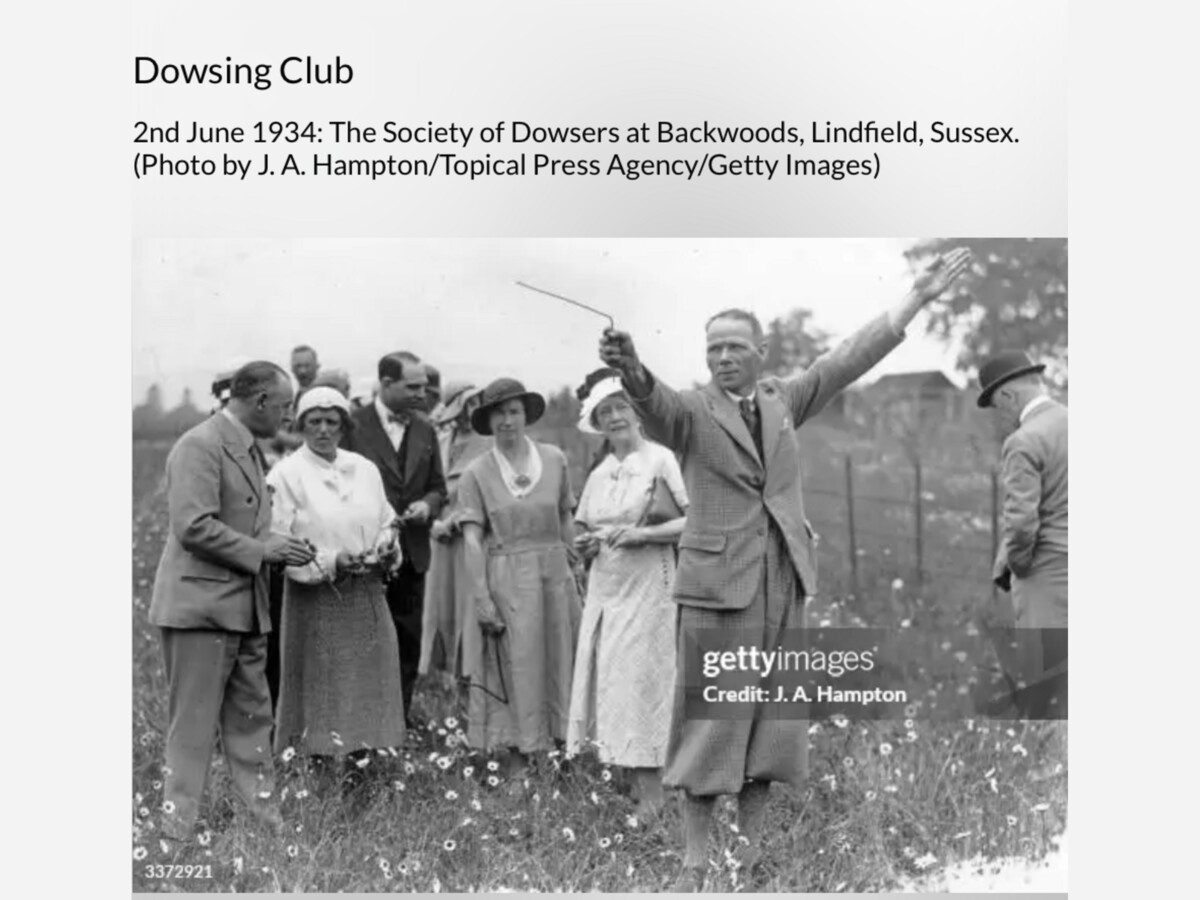
June 2, 1934: The Society of Dowsers at Backwoods, Lindfield, Sussex. Photo by J.A, Hampton/Topical Press Agency/Getty Images.
Editor's Note: Just a reminder: Goshenhoppen Folk Festival begins today, August 7--12-8 p.m. Saturday 10 a.m.-6 p.m. Find Bob at the Antes House 12-4 p.m.

by Bob Wood
In these times, most old superstitions have fallen by the wayside, but dowsing’s many believers robustly defend this ancient practice. I am acquainted with scientists and engineers who have practiced dowsing and swear that it works for some people in finding water, buried pipes or water leaks in pipes.
Some years back when I lived in Moreysville and applied to be connected to the Boyertown borough water system, the borough manager arrived with two “L” shaped rods about a yard long which he let hang loosely from his hands. He slowly walked along the street; when the rods crossed, apparently by their own volition, the buried pipe was located.
Skeptics and non-believers, on the other hand, ask how this could possibly work? There are no known principles to explain dowsing. Dowsing, skeptics say, is not based on any known scientific or empirical laws or forces of nature, so it is just magical thinking--- occult thinking; and the supposed “finds” are mere chance. The believers respond, “Just because you don’t understand it, doesn’t mean it can’t exist.” In short, they maintain that dowsing works by presently unknown forces, but the mechanisms of its function could, someday, be discovered.
The most common dowsing rod is a wish-bone shaped stick held in a variety of ways, but usually clenched in the fists with the point facing away from the dowser at chest height. The stick can be anything: green or dry wood of any type, wire, metal rods, coat hangers or even a pair of pliers.
Also popular are wires or rods bent into a “L” shape with the short length held loosely in the fists at chest height and about six inches apart. With the longer lengths pointing away at chest height, the seeker walks slowly along, when the wires cross he is over the spot.
The dowsing rod itself can be anything. An article in a 1961 Pennsylvania Folklife describes an Amish water dowser who is shown using a pair of pliers, being first careful to wear stout gloves so that the violent downward twisting of the pliers won’t tear the skin on his hands.
What the dowser finds seems to depend on his intention. One can dowse for such things as water, buried pipes or other metal, ores, gemstones, oil, gravesites, or even lost golf balls, but water is by far the most common quest of local dowsers. In a modern twist, dowsing had even been touted as a method for discovering buried bombs and land mines in war zones. Whether this has ever been tried is unknown.
The origin of the dowsing rod is lost in antiquity, but it first seems to have come into common use by 16th German miners as a means for locating veins of metallic ore. One old treatise notes that its use stems from “…the belief, once universal among educated men…that metallic ores attracted certain trees which thereupon drooped over the place where those ores were to be found, the drooping no doubt being due to the soil or other causes. A branch of the tree was therefore cut and held to see where it drooped. Later on a branch was held in each hand and the extremities tied together.”
During the reign of Queen Elizabeth (1558-1603), German miners were imported to Cornwall which introduced the divining rod to England, and by the end of the 17th century it had spread throughout Europe. Everywhere it aroused controversy. During the 17th century (the 1600’s), there were no fewer than 89 books and pamphlets about dowsing published and circulated throughout Europe.
Today, using the words “sympathy” and “attraction and repulsion,” proponents of the divining rod cited such phenomena as gravity and magnetism to offer an explanation for the physics of dowsing. The adversaries, on the other hand, condemned it as a superstitious and vain practice. Moreover, they assert it is fundamentally useless, “If they once point rightly they deceive ten or twenty times.”
Does dowsing work? Obviously many people believe it does. Predictably, the internet has no scarcity of web sites on the topic. Especially prevalent are dowsing products for sale.
If the internet is to be believed, one site notes, “Typical is what happened when James Randi tested some dowsers using a protocol they all agreed upon. If they could locate water in underground pipes at an 80% success rate they would get $10,000 (now the prize is over $1,000,000). All the dowsers failed, though each claimed to be highly successful in finding water. Randi says, “…The sad fact is that dowsers are no better at finding water than anyone else. Drill a well anywhere in an area where water is geologically possible, and you will find it.”
I propose a further test for dowsers. Ground water being so prevalent in the New Hanover area, dowse a site where you can drill a few hundred feet and NOT find water.
In any case, believers will believe. There has always been a great attraction toward the idea that something exists, invisible, under the surface of the everyday. And skeptics and non believers will continue to say, “Show proof.”



Sunny, with a high of 66 and low of 42 degrees. Sunny during the morning, clear during the afternoon and evening,

Not badly done for a former journalism teacher and school newspaper advisor. Thank G_d there was no need for collating or paste-ups.



Interesting, Bob. Thanks, but I wonder how that related to people’s probably very strong religiously beliefs back then —-not the fact that there’s evil, but that there’s some kind of symbol that can stop it; that sounds more like witchcraft.
Religion and superstition have always co-existed. For an example, see any devout Christian in the area who also has a "lucky" Eagles jersey, or believes that wearing their baseball cap inside out will help a rally keep going...