38° and Clear
Image



by Bob Wood
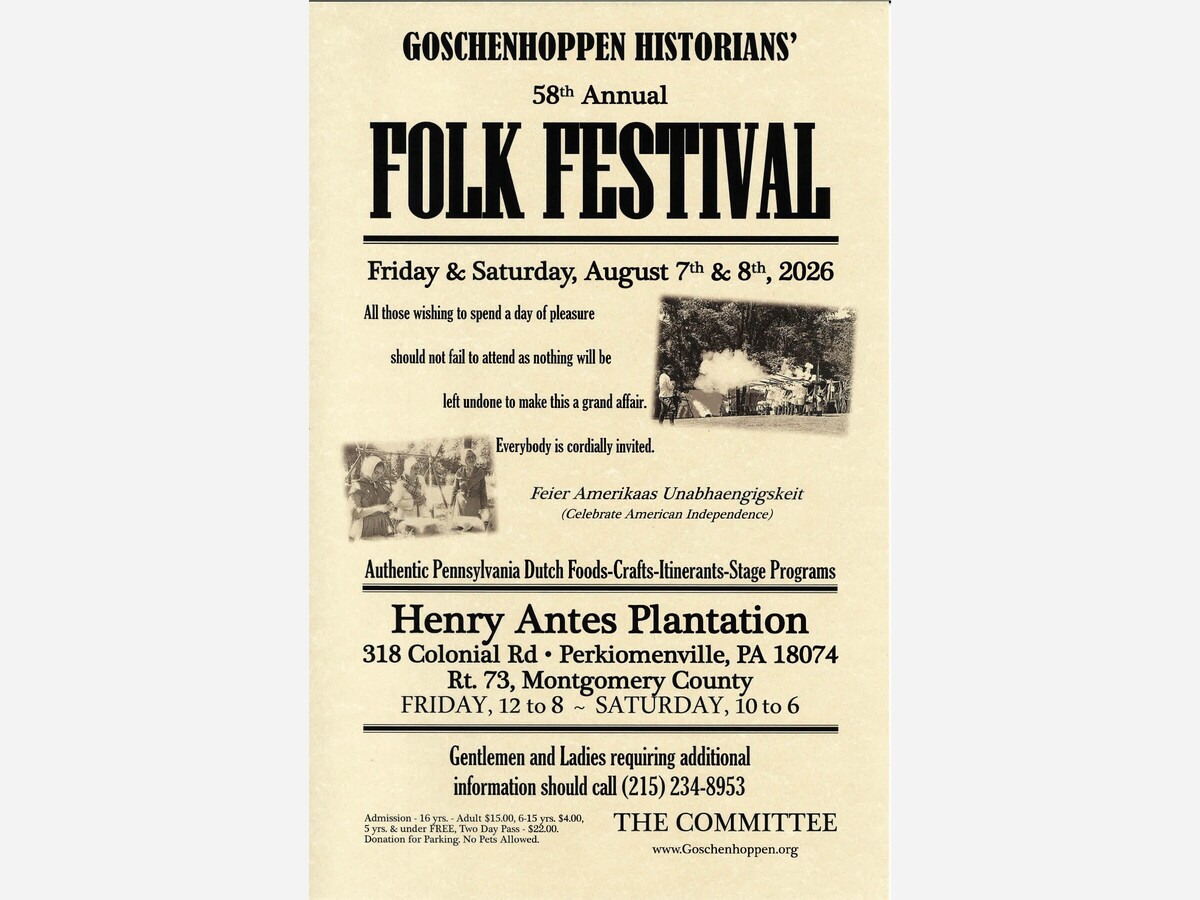
The Goschenhoppen Folk Festival will be held, rain or shine, at the historic Henry Antes Plantation on Colonial Road in nearby Frederick on Friday and Saturday, August 7 and 8. Produced by the Goschenhoppen Historians, the Festival has gained national recognition for its attention to detail and authentic reproduction of 18th and 19th century Pennsylvania Dutch folk-life.
The festival traces its roots to the middle part of twentieth century when it became obvious that the Pa. German folk culture of Upper Montgomery and Bucks Counties, which had existed since the early 18th century, was rapidly passing away. The use of the German dialect was diminishing; farm auctions saw items of the material culture sold and dispersed while the farms themselves were often broken up for tract housing.
Concerned that nothing was being done to record and preserve two-and-a-half centuries of unique farm and village culture, in 1961 folk life scholars and friends Robert Bucher of Harleysville, “Isaac” Clarence Kulp of Vernfield, and Arthur Lawton of Indian Creek, and others began meeting and discussing the passing scene with like-minded people. After meeting informally for a few years, in 1965, they incorporated into the Goschenhoppen Historians. The organization was chartered to collect, preserve, and present to the public the folk culture and history of the Goschenhoppen folk region and surrounding areas of Southeastern Pennsylvana.
The late “Abe” Roan, an early member of the Historians, wrote in a 1996 issue of Pennsylvania Folk Life magazine: “In the 1960’s most preservation societies in the United States existed to protect and maintain historic buildings and paper items. The Goschenhoppen Historians, however, were committed to a European model of historical and folk cultural research which broadens the base of study to include languages and dialects, folk beliefs and folk practices, material culture, and geographic, historic, and religious influences. Utilizing these cross cultural studies, the full range of a culture—and the subtle relationships that make it function—can be better and more completely understood.”
In 1967, at the Old Goschenhoppen Union church in the village of Woxall near Sumneytown, the Historians organized the first “folk festival” with about thirty demonstrations of traditional Pennsylvania German activities. The second festival had about forty demonstrations as well as a stage program and food sales. The next year it moved to New Goschenhoppen Park, East Greenville, where it grew and prospered for thirty-nine years until it was relocated to the Antes Plantation in 2007.
Roan writes: “The folk festival has been described as 'living history,' which is exactly what its founders hoped it would be. As such, it covers the full range of life experiences including religion, home life, folk customs, decorative arts, clothing, food, agriculture, trades, and folk medicine. Traditional activities demonstrated or portrayed are based on local application within the Goschenhoppen folk region. After the presence of a particular skill, craft, or activity had been established by historic documentation and by oral sources, the festival committee seeks a demonstrator who is both skilled and capable of doing research to assist in localizing the demonstration he or she is being asked to set up.”
Festival visitors often comment on the number of young people involved. From the start there has been a strong educational component to the Historians' mission, and to that end there has existed an apprentice-master craftsman program where young people, in costume, work side by side with highly skilled demonstrators. Many of these young people come back year after year---some all during their secondary school years---and develop a working relationship with their “masters.” Roan writes: “Many of these young people are not of Pennsylvania German stock and it would seem that their response to learning the heritage of the Goschenhoppen folk region is a testimony to the folk life approach employed by the Historians and to the spirit of pride, self-discipline, and personal responsibility they see in the organization’s workers and adult leaders.”
When you go to the festival, don’t look for amusement park rides or plastic tchotchkes, and there’s not a “hex” sign on the place. Any crafts that are offered for sale must have been made by the artisan selling them.
A testimony to the authenticity of the event is the comment of a visitor who complained that he couldn’t find a hot dog or hamburger. Food is true Pennsylvania German; you will not find French fries, hamburgers or soda. There are plenty of foods for sale, but they are all traditional Pennsylvania Dutch, typical of the Goschenhoppen/Falckner Swamp Region in the 18th and 19th centuries.
I haven't been to the folk fest since I worked it as a teen helping to make apple butter. I hope the schnitz and knepp is still as good, and that you can still get vanilla ice cream with peaches. I still have some blacksmithed items from those years kicking around.
Not sure why the festival was moved as the location in East Greenville was nice. I volunteered as an apprentice for the ink maker when I was in seventh grade over 40 years ago.....

Sunny, with a high of 58 and low of 36 degrees. Sunny in the morning, clear in the afternoon and evening,