

Image
by Mike Strzelecki*
Estimating bird populations is an exercise in futility for ornithologists. Birds are elusive and often hide out in remote and complicated habitats. They are mobile - not just in reference to migrations, but also within seasons as they search for food and suitable breeding habitat. They often migrate at night, unseen. Counting methodologies are scientifically rough, and counting birds is labor-intensive and expensive.
Certain birds, however, present themselves much better to being counted. Raptors are birds of prey. They include hawks, eagles, and falcons, among other species. Whereas most birds migrate at night, under the safe cloak of darkness, raptors migrate during the day. This is because they rely on thermal updrafts and air currents driven by the heat of the daytime sun to move large distances. They often migrate along the same geographic pathways. For these reasons, counting migrating raptors year-after-year can offer insight into raptor populations, and how they are changing over time.
With this in mind, a multi-national organization has sprung up to assist ornithologists and other scientists in the study of bird populations. The Hawk Migration Association was founded in 1974. Through core employees and a prodigious army of volunteers, they further the research of raptors and also run about 200 hawk counting stations in the United States, with others in Canada, Mexico, and Central America. They try to have coverage at all of the counting stations every day, during all daylight hours, during the raptor migration season - generally from late February through May for the spring migration, and from late August through December for the fall migration. Each official hawk watcher invests thousands of hours of volunteer time over their volunteer stint, showing up in even the most severe weather.
For these volunteers, counting migratory raptors is a way of life.
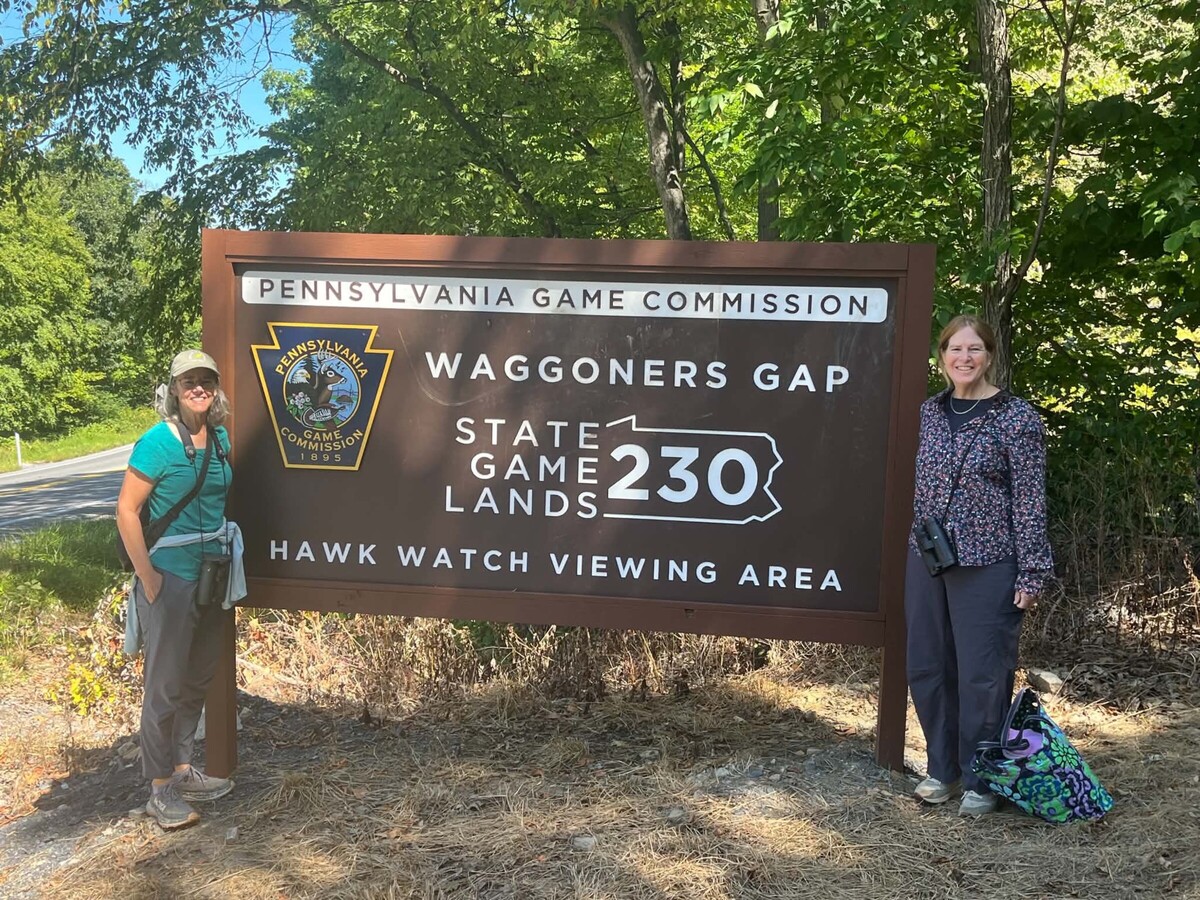
The closest official hawk counting station to Boyertown is at Hawk Mountain, near Hamburg. My wife Kelly and I, along with our birding friend Nancy, had the pleasure of spending the day recently with a team of hawk counters at a different location - the Waggoner’s Gap hawk watch station, located on a steep mountain ridge overlooking the Cumberland Valley, near Carlisle.
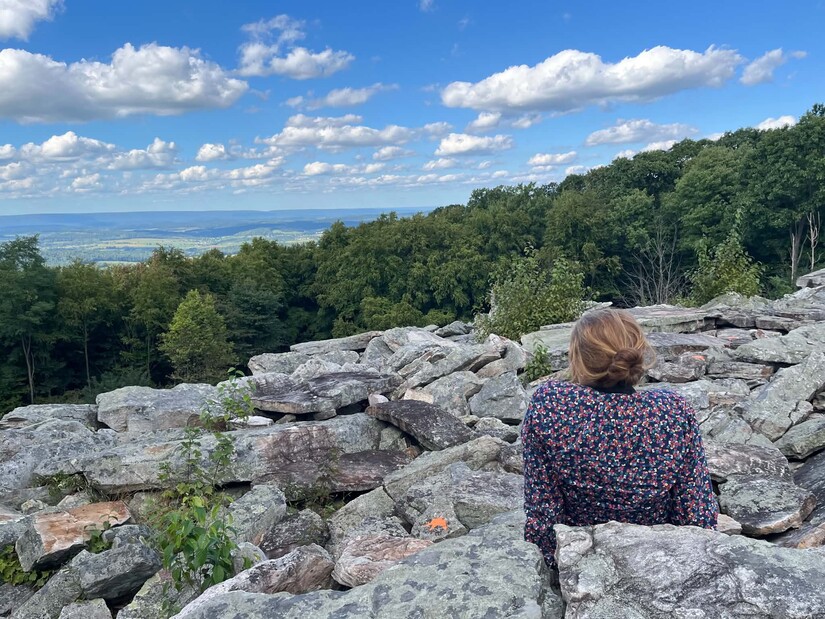
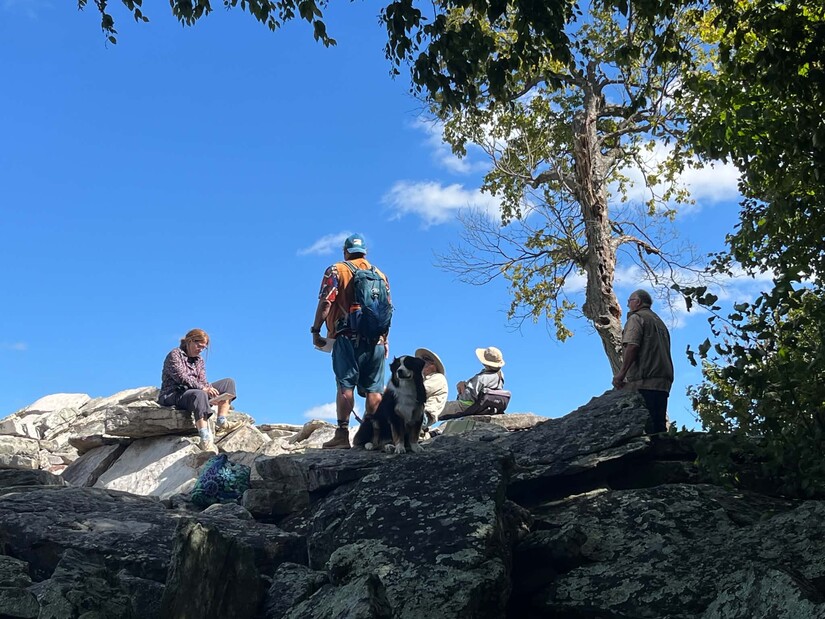
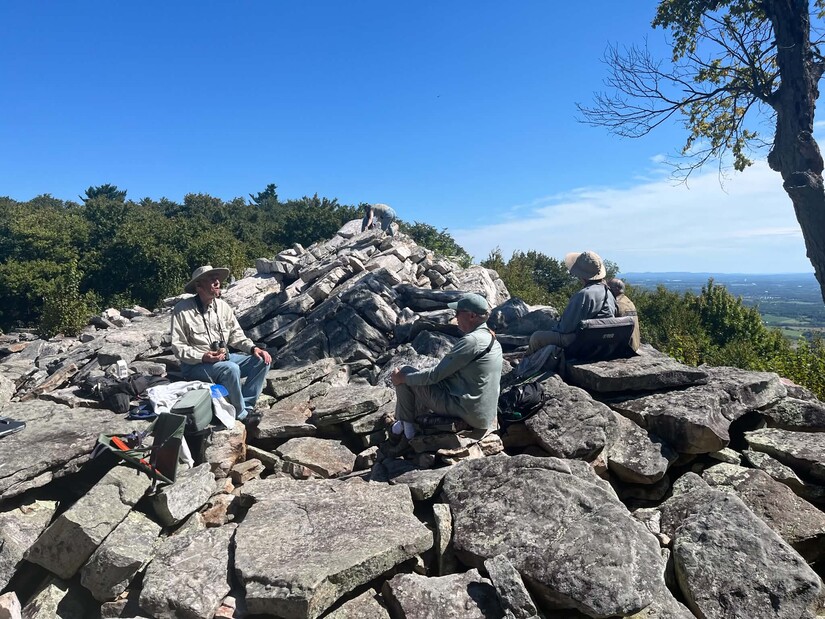
Waggoner’s Gap is about two hours from our house near Baltimore. We were able to drive up the steep ridge to the hawk watch parking lot. A 5-minute uphill hike landed us atop a rocky outcrop shooting up from the heavily wooded ridge, offering 360-degree views of multiple valleys. There were about six official counters there when we arrived, perched across the lookout on rocks, binoculars cast skyward. Our eyes were immediately drawn to the jaw-dropping views. Hundreds of square miles of landscape unfurled before us. I decided that spending an afternoon perched atop a mountain lookout, scanning the landscapes and skies for anything interesting was a lovely way to spend an afternoon.
The hawk watchers at our station were affable and silly. Hawk counters enjoy sharing their knowledge with visitors (birders enjoy showing off their knowledge and love trying to get others invested in the activity). They shared with us handouts delineating the appearance of the different raptors when seen from below. They provided us a fall calendar showing when they expect different species of raptors to migrate through. They even spent generous time with us pointing out mountains, towns, and other landmarks seen in the distant horizons. Between passing birds, we chatted about paw paws, great local restaurants, and Penn State football. We stayed for over five hours before our grumbling stomachs sent us strong messages to move on.
On this particular day, the weather conditions were not conducive to a large-scale migration, but we still saw many individual raptors as well as small groups (called “kettles” in birding vernacular) moving through. The lead counter tallied the birds seen throughout the day, and then input the birds seen into an expansive international database. During that particular day, we saw 345 broad-winged hawks pass overhead, a northern harrier, 55 sharp-shinned hawks, 2 Cooper’s hawks, and 9 red-tailed hawks. As far as falcons go, we observed a merlin and 3 American Kestrels. We also tallied 21 bald eagles and 4 osprey. While I am no hawk-counting expert, I felt that was a significant haul for what others were describing as a bad day.
Scanning the databases of other hawk watch stations on that particular day, I noticed that a station in Veracruz, Mexico, tabulated an astonishing 22,640 Mississippi kites passing overhead within those daylight hours. I also checked the database for the Hawk Mountain watch station which is just up the ridge, and along the same flyway, as our station, and found their numbers for the day to be similar to our numbers. The link to the official database is:
The hawk watchers appreciate visitors stopping by and helping with the raptor spotting. Some raptors are seen flying low overhead, offering great views to the watcher. But for the most part, the birds are often far away, either high in the sky or off towards a distant horizon. And even through binoculars, they appear as little more than a dark shadow moving swiftly across the landscape. We were impressed at the hawk watchers’ abilities to identify birds so quickly and resolutely. We would see a very distant glimpse of a dark blob darting across the landscape or disappear quickly into a cloud. We could not even wager a guess as to its identity, but would hear such discussion as, “that has to be a sharp-shinned hawk and not a Cooper’s hawk because the tail feathers were slightly rounded.” It was clear that these volunteers have been doing hawk watching for years, if not decades, and are experts in their field.
Kelly and I scanned the migration calendar for fun times to help with the hawk watching later in the fall. Golden eagles are very uncommon birds in our area (I have only seen one in the mid-Atlantic region in decades of birding), but they regularly pass over our region during migration. They are scheduled to move over our area in decent numbers in December. We hope to be there, on our remote hawk watch lookout, packing a warm jacket and a thermos of hot chocolate.
*Mike Strzelecki is a freelance travel and outdoor writer, and 1981 graduate of Boyertown Area Senior High School. He writes from his house in Baltimore, Maryland. In his spare time, he joins his wife on adventures around the country observing and photographing birds.


Sunny, with a high of 71 and low of 51 degrees. Sunny in the morning, clear during the afternoon and evening,