

Image
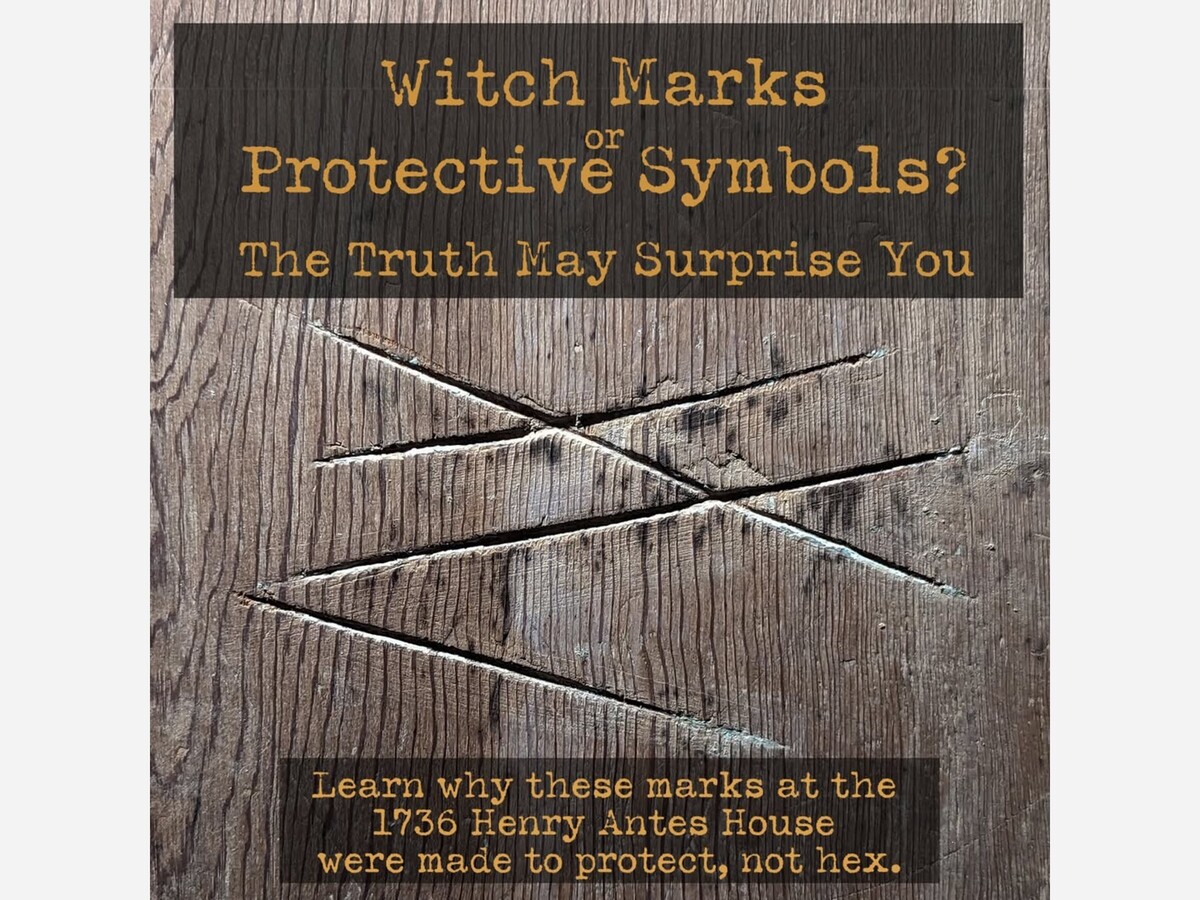
photo from Goschenhoppen Historians Facebook page
by Bob Wood
Because some of the original architectural fabric of Henry Antes House is intact, we can still at this late date make new discoveries.
Recently a visitor pointed out an incised “X” marked at the end of the holding bar of the door latches. He noted that this was an “apotropaic mark.” A new word to me, “apotropaic” is a noun meaning “having the power of averting evil influence.” The latch we were looking at is a reproduction where the blacksmith faithfully reproduced the original since several of the original door latches still in place do carry this mark. According to this interpretation, the doorways of every interior door are so guarded against the entry of malign influences.
It does appear that the marking was intended as an apotropaic as there are numerous photos and references found on various on line sources that vouch for the intention of this practice.
We can find other markings in Antes House that could be interpreted as protective devices.
First, Around the interior of the entry door that faces the garden (which is believed to have been the original main door) are remnants of an encirclement of round, stamped prints in red paint about an inch-and-a-half wide with a white” +” sign in the center. The “plus” sign could be interpreted as a Crux Christi, the cross of Christ and as such a strong protective device. The red paint is on the original stones of the entry and was found under the many layers of whitewash and paint. This strongly suggests that it was applied at the building of the house as an apotropaic device.
On the other hand, we must note that we can’t be sure they weren’t simply colorful decoration.
The frames of both exterior kitchen doorways are reproductions so whatever markings that may have been on the originals may be lost; however, the original frames were placed in the house attic and may merit a close inspection.
Also, on the second floor at the head of the stairs are incised markings in the perfect center of a door panel . This is the door to the room directly above what we call the Kammer or first floor bedroom. Some of us entertain the possibility that Antes may have used the first floor Kammer as an office and his actual bedroom was on the second floor directly above. Hence the locking wall cabinet in that room, as well as a key lock and a protective mark on the entry door. It would make more sense to have a first floor office and a second floor bedroom. Antes was a mill owner, business man, religious and civic leader and all-around man of influence and so would logically have required a convenient office for frequent visitors and business dealings.
The door markings describe an “X” similar to the door latches and a “V.” These appear to have been cut with a rase or race knife. This may suggest that they were inscribed at the house construction since a rase knife (another word new to me from the French, racloir: a knife with a hooked tip for making grooves) was a scribing tool, according to on-line sources, universally used in bygone years by timber framers and boat builders and others to mark timbers. The Roman numerals frequently found on rafters and timbers of old structures were sometimes cut in with a rase knife—it is claimed—and not a hatchet or axe.
The door inscriptions don’t appear to be Roman numerals. There is early paint residue deep in the grooves indicating that the markings are not recent. It is hard to think that an owner would mutilate a door surface in a more or less new house for no point or purpose. According to online postings, “X” and “V” are commonly used apotropaic markings. The meanings, if any, are unknown; however, “X” is the first letter of the Greek alphabet for the word “CHRIST.”
It should be noted in closing that the majority of apotropaic markings and devices are usually found in barns; the barn in the Dutchman’s view being vastly more important than the house. That Antes House retains some of these markings reinforces its value as an architectural museum and lauds further kudos on the original Historians who as early as the 1960’s saw the value of the house and retained as much of the original architectural fabric as possible in the restoration.
Finally, We might ask by what process did the makers of these apotropaics think that they worked? I doubt if they thought of a “process” at all. Even in our lifetime if you were to ask an old Dutchman how such things “worked,” he would feign ignorance about what you were asking and then angrily dismiss you and your questions. He might say, “They work! That’s all you need to know.”
Today, it might behoove us not to dismiss or dishonor these elements of the ancient and sophisticated culture of our forebears. Rather, perhaps, respect a world view that sees an underlying subliminal connectedness where things unseen and unknown can inform our daily life. Of course the dominant world view of our age is to see the whole world as made up of dead stuff to be chopped up and utilized for our profit. We will see how that works out in the end.
* An inspiring Jack of all trades, master of many, Bob Wood serves as Studio B's Gallery Adjunct when he's not busy doing everything else! Writer, artist, potter, historian, and volunteer. Bob began his career as an artist following his retirement from teaching Language Arts. Bob is a popular speaker; local history is his niche. Bob has published four books on local history.


Sunny, with a high of 64 and low of 40 degrees. Sunny in the morning, clear in the afternoon and evening, overcast overnight.