44° and Cloudy
Image



by Jane Stahl
Poet John Yamrus is a prolific published poet with over four dozen books to his name. He's translated and published internationally. Thousands of poems have been published in assorted magazines over his 50-some year career. His books are used in college and university writing classes.
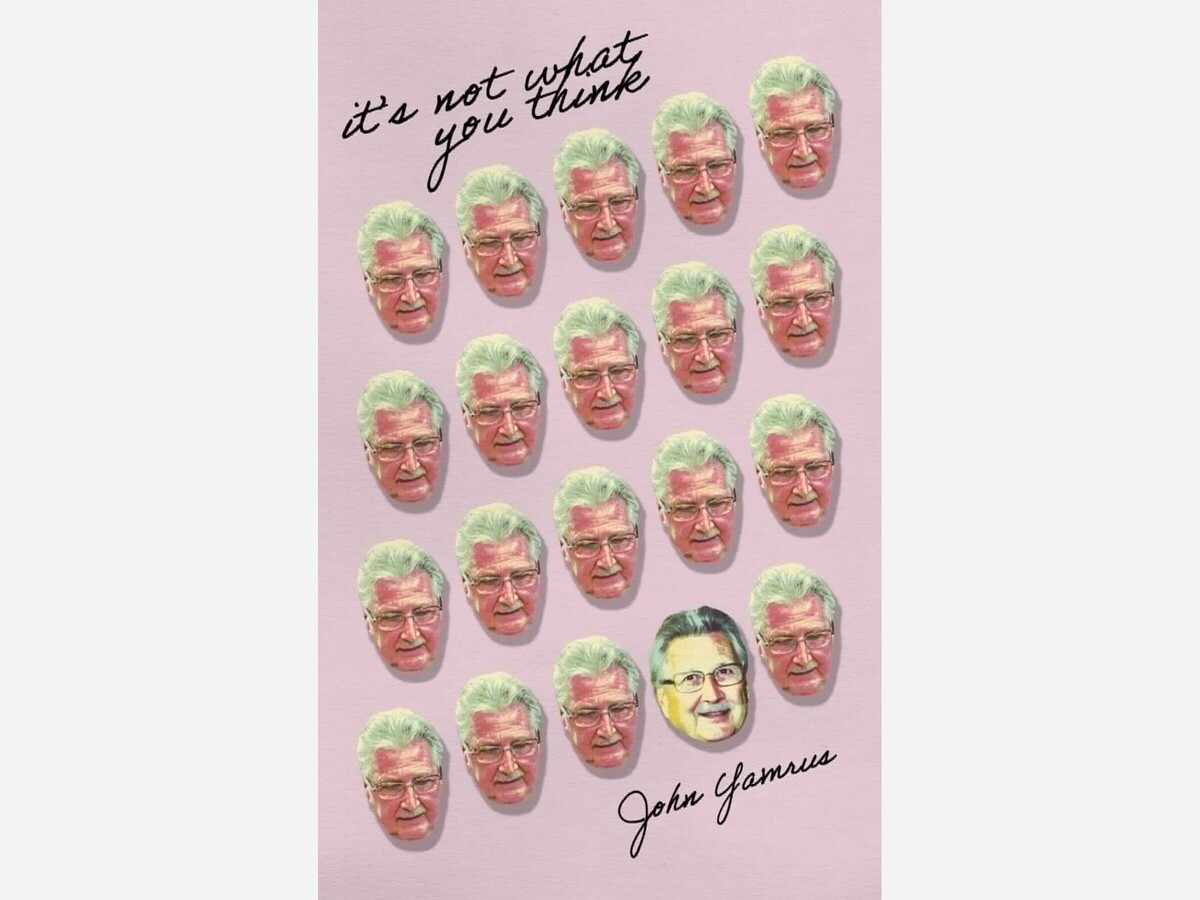
As a minimalist, John's poems utilize as few words as possible to set a scene, introduce a person, express a thought or feeling. Start reading his poems, time dissolves; and before you know it, you've read the entire book. But the words stick, the feelings linger, and you feel you know John's world and mind a bit better (or for worse!). His latest book--IT'S NOT WHAT YOU THINK--has just been published by Chicago's ANXIETY PRESS.
But don't take my word for anything, let John's fellow poet and educator Phil Repko share his thoughts about John's book and the marvel of his poetry.
“It’s not what you think” by John Yamrus.
~ A review by Phil Repko
If I channel my inner or outer John Yamrus, I might respond to the title of his latest book with great indignance. How the hell does he know what I think? And if he does, how arrogant of him to tell me I don’t know my own mind! I mean, for all he knows, it could be exactly what I think.
But I am not John Yamrus. I have not written close to fifty books over the past half-century. Many of these books most heavily lean into minimalist and neo-noir poetry. Those two terms get thrown around pretty regularly if you happen to follow John Yamrus, and I suspect that John is privately - or not-so-privately - getting tired of the labeling.
That is not to say that the labels are wrong, or misleading, or in any way damaging. It’s just that putting 50 years of his output into a neat little box will probably rub John the wrong way. Of course, anything with pretense or pretext will likely rub John the wrong way, and he will get even with insightful, acerbic, or witty barbs that always strike true.
Let’s start the poetry discussion with the intro to the book. Yamrus, for fun, ponders whether his writing even qualifies as poetry. He shares one reader’s opinion that without rhyme or meter, there is no poetry. Now, that contention has been challenged for more that a century, in our neck of the woods, but historically and globally, poetry has been reluctant to wear any confining labels.
I think the poetry in this latest offering is rather easily found in a theory championed by Hemingway. Now, John may not like this connection, or he may find it flattering. Regardless, Hemingway defended a technique of telling his stories without pretense, without bluster, and without flamboyance. Acolytes made much ado about his Iceberg Theory, but there is something to be said, and to be admired, in the skill of letting the story tell itself.
Early in the book, Yamrus shares a gem, “my friend Bill James played the blues, kinda.”
No one will be reading this poem in a stilted, stentorian style. There is no bombast.
The miracle of the poetry is in the power of discipline, telling only what needs to be told, and having the reader undress it to find the naked beauty beneath.
I will leave it to the reader to find the second poem in the book, one a bit longer than Yamrus usually crafts, and to take the seemingly casual stroll. What the reader will find on the walk is the magic of seeing things we don’t notice when we are preoccupied by life.
You see, Bill James’ vignette isn’t long enough to be a story. That tragedy is more important than the rhyme, or the meter. Quite simply, Bill James wanted to play the blues, but that desire never blossomed into full flower.
Yamrus, (in the opinion of this writer, (me) who is something of a slave to tradition, convention, and the canon,) is a master of control. He doesn’t just strip things down to bare essentials, he makes it impossible to ignore the beauty of the nudity.
Bill James lived the blues, for a minute, and then didn't. The tragedy isn't his falling short of his aspirations; the tragedy is the life he didn't live. Yamrus turns his readers into poets by dancing them to epiphany. Toward the end, the writer matter-of-factly shares that Bill James hangs himself. But the grisly description is withheld. The truth can shine brilliantly without elaboration.
In a later poem, “he liked it,” the poetic moment comes with some crudity. The indiscriminate ‘she’ could be any ‘she.’ The writer notes that her feminine sensibility shuts him down cold, a few times each week, so she can wallow in her own unhappiness. “He likes it,” he says.
He also recounts her saying not to let ‘them,’ the unidentified world “shit in your ice cream/and try to serve it to you cold.” What he isn’t quite saying is that the moments of wallowing may well be artifice, something ‘he likes.’
He also respects the homespun wisdom. Cold shit is still shit. Don’t fall for the ruse that it can ever be a treat.
And, since I have already stolen the idea, and used it above, it seems only fitting that I conclude the presentation of the nuggets of poetry with “you can’t.”
stare
at a painting of
a naked lady for too long,
without
people thinking
you’ve been staring at it
for
too long.
Here, the fact of self-consciousness, and our slavery to public scrutiny is laid out for observation. What’s not included here is the why. It is innately human to stare at beautiful things. Please note that there are few paintings of grotesque naked ladies. Or, perhaps the poetic magic is that there would be no need for the viewer to be self-conscious if the subject were not alluring, and perhaps even compelling in her nudity.
What the poet (and Yamrus is nothing, if not a poet) leaves out is the poison of public opinion. He cannot stare too long because someone will think he’s a creeper, or a pervert. Worse, the all-powerful societal judgment may label him a danger and a threat.
John’s latest book is not so much divergent from his earlier books. He has written almost fifty, and I haven’t read them all. But having made my way through Collected Poems, I have taste-tested a good portion. To me this one seems to a bit more concerned about the value and the implications of the observations. The writer’s skepticism, edge, and the irreverence seem to be turned down just a notch.
Oh, there is plenty of attitude and feistiness to be found in this volume, much like the others. Yet it seems this collection is still squinting and ruminating on what all these snippets of life might mean. He seems less inclined to wave off any suggestion that his cut-to-the-chase style means the details aren’t important.
If that doesn’t make any sense, I ask you to turn to page 42 and read “she thought.” It may not change anything, but it may make you want to take stock of all the things out there - things to not care about or fret over – or not. This volume seems to hold out the possibility that these might be poems after all.
##

John urges, "If you can, please go to Amazon and pick up a copy. You'll be supporting one of the best small presses on the scene today...as well as supporting a fine small business! And who knows...ya just might like the darn thing! Thank you!" Order on Amazon


Interesting, Bob. Thanks, but I wonder how that related to people’s probably very strong religiously beliefs back then —-not the fact that there’s evil, but that there’s some kind of symbol that can stop it; that sounds more like witchcraft.
Religion and superstition have always co-existed. For an example, see any devout Christian in the area who also has a "lucky" Eagles jersey, or believes that wearing their baseball cap inside out will help a rally keep going...

Sunny, with a high of 59 and low of 43 degrees. Sunny for the morning, overcast during the afternoon and evening, clear overnight.