Image
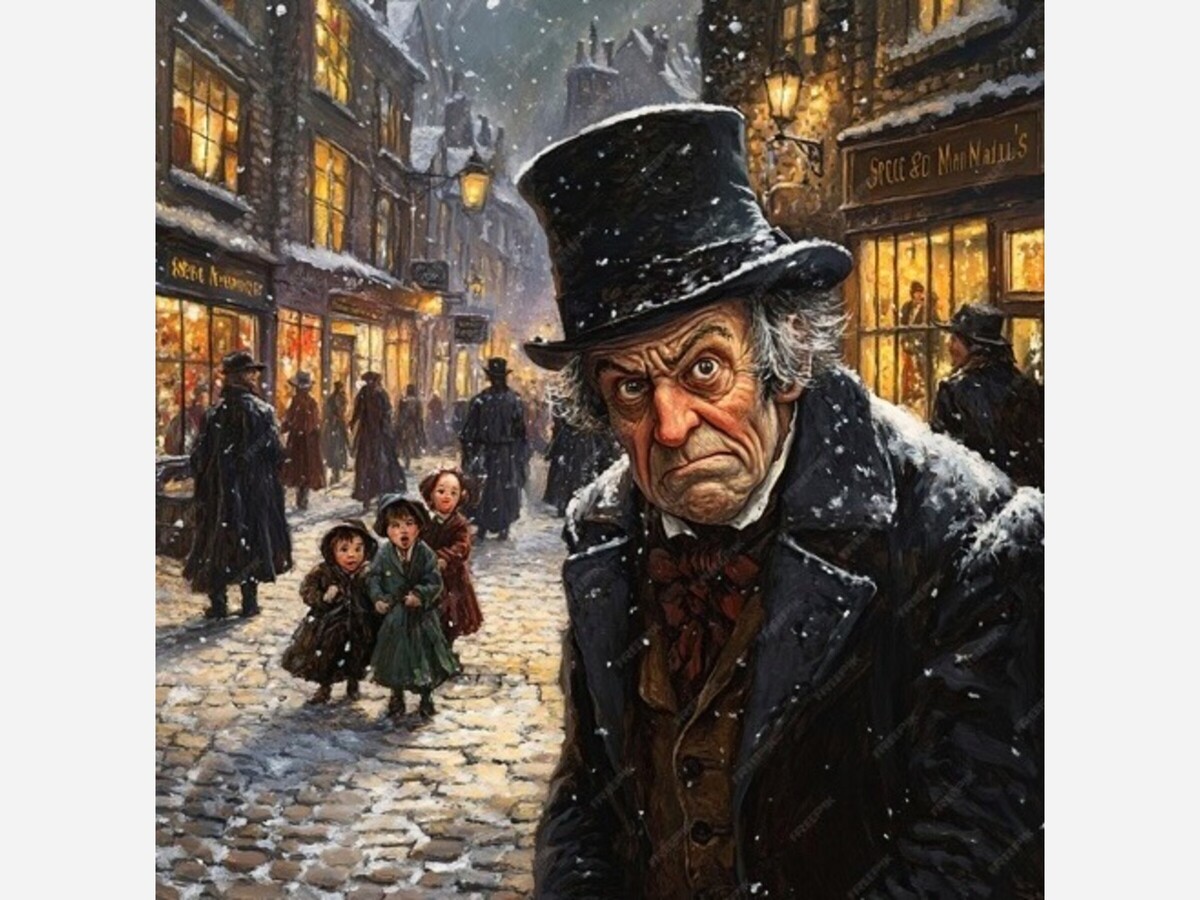
photo from FreePik
by Craig Bennett*
Those who have known me for longer than a couple of decades will probably recall that I used to be a fair hand at calligraphy. Still am, probably; I just haven’t practiced it to any extent for quite a while. But every now and then I give my largely dormant lettering chops some exercise by producing something brief, simple, and satisfactory. It was such an occasion that accounted for my one and only Christmas decoration, which has graced my front door from Thanksgiving to New Year’s Day for at least the last dozen years.
It’s a small sign, of sorts, on a 5x8 file card, featuring English Gothic letters that make one think of bygone times in merry old England and holiday scenes such as Charles Dickens described in some of his stories. This modest decoration, in fact, brings to mind the most famous such story: “A Christmas Carol.” Within a border of red and green, with a couple of holly leaves and bright red berries in each corner, those archaic and ornate letters spell out, “Bah! Humbug!”
Needless to say, I get questions from the few people who have occasion to knock on my door during the Christmas season. “Don’t you like Christmas?” they ask, an expression of puzzlement on their face. “Are you an atheist?” “What is this? Some kind of joke?” And so-on. But I’m glad they ask because it provides me an opportunity to explain.
“OK,” I begin. “Think about that story for a moment,” meaning Dickens’s “A Christmas Carol.” Being careful to employ the grammatically correct objective case, I continue. “Whom was it all about? Was it about Tiny Tim? Bob Cratchit? The Ghost of Christmas Past?”
“Well, no,” they offer hesitantly. “I guess it was really about Scrooge.”
“Of course!” I confirm. “The story was really about Scrooge and his marvelous transformation from a miserly, misanthropic old skinflint to the very soul of the Christmas spirit!” I pause for just a second or two to let that sink in, and then, “And all that anybody remembers is, ‘Bah! Humbug!’”
If they’ve been paying any attention at all, it suddenly begins to dawn on them that there has been a great injustice committed here. As a result of the visitations of the Ghost of Christmas Past, the Ghost of Christmas Present, and the Ghost of Christmas Future, Scrooge has his own on-the-road-to-Damascus moment. He wakes up, sees the light, and realizes he’s not only making many of the people around him miserable with his attitude and behavior, but he’s also been depriving himself of a great deal of joy to be had through acts—and attitudes—of kindness, generosity, benevolence toward others, and a feeling of gratitude for the many blessings that life has to offer. He then sets out immediately to buy a Christmas goose and take it as a gift to his employee Bob Cratchit for his small family’s Christmas dinner.
But Scrooge is the main focus of the story. He’s the main character. The tale is told through his eyes, his awareness, his memories, and his transformative experience. If the story has a “hero,” Scrooge is it. And all we remember him by is, “Bah! Humbug!”
“Phooey!” says I. Let’s strike a blow for the underdog! Let’s greet people this Christmas season with “Bah! Humbug!” so that we can enlighten them, as I have just enlightened you, as to who really deserves the credit for the place that this touching story by Charles Dickens has held for over two centuries in the hearts of people all over the world who love Christmas and who look forward to it as the only time when their whole society celebrates the humane and spiritual qualities that Scrooge had to rediscover through some frightening Christmas Eve encounters with a trio of Ghosts who provided him with a glimpse of himself as others see him.
“A Christmas Carol” is just a story, but the lesson it teaches is real and vitally important, especially at the present time. “Peace on Earth, good will toward men” needs desperately to replace the hostility, suspicion, resentment, fear, and hatred that have come to characterize human relations at all levels and in all areas of life over the past decade, if not longer. If we fail to learn the lesson that Scrooge came to exemplify at the end of Dickens’s story, we’ll find ourselves to be richly deserving of the scorn, contempt, and misanthropy expressed by Scrooge’s (unfortunately) most famous utterance: “Bah! Humbug!”
*Craig H. Bennett, author of Nights on the Mountain and More Things in Heaven and Earth, available at amazon.com, barnesandnoble.com, and most book stores


Sunny, with a high of 79 and low of 63 degrees. Sunny in the morning, mist overnight.


Thanks for this exposure, Jane & Leslie! Hello to everyone in Boyertown!






Dear Jan - Thank you for this article! I love the Overview Effect. planet first, society second, economy last