58° and Partly Cloudy



Image

by Craig Bennett*
Ren Hurst spent twenty years as a professional horsewoman, training horses to fit into our ultra-civilized human world in exactly the way we would wish them to. Horses, of course, have served human beings in a modest variety of capacities for thousands of years. Her book The Wisdom of Wildness, however, is not about horses; it’s about a dog. Sometime before its writing, she had taken in a stray husky, pure white and irreconcilably wild. She named it “Denali,” as in Alaska’s highest mountain, renamed Mount McKinley by its white “discoverers.” Denali would run away constantly. She would raid the neighbors’ chicken coops and menace their smaller livestock. When introduced to Hurst’s long-time canine pet, Spur, she attacked the other dog immediately. Hurst realized that this dog needed rehabilitation and needed it badly, but she wasn’t sure what that might entail in this particular case.
She tried to teach Denali to obey simple commands. Denali refused to learn. She tried to domesticate Denali so that the dog could live with her, Spur, and the other animals in her care; but Denali wanted no part of it.
Hurst became frustrated with Denali and tired of going to fetch her somewhere in their extensive rural neighborhood every time she ran away. She began to wonder if the hope, the anticipation, the time, and the energy she was putting into the efforts to civilize this still wild animal were really worth it.
Then one day she happened to see Denali head for the nearby mountains on her own and hurried out the door to give chase. She could hardly keep up with the dog, but she did manage to keep Denali in sight most of the time. She called after Denali repeatedly, but the dog ignored her. Maintaining pursuit was an exhausting and frustrating effort, and she soon grew weary from following a fast-moving smaller animal up the increasingly steep slope of a mountainside.
But Denali had moved across the face of the hill and started back down in the direction of a nearby road that Hurst wanted her to avoid at all costs. They came to a creek, and Denali had paused slightly on the other side. Hurst, in a moment of pure desperation, tried to leap across the creek to where the dog stood; but she was exhausted and landed in the middle of the creek, soaking herself from the waist down and gasping for air. She was at the end of her rope, and Denali was only a few yards away.
As her body surrendered to the accumulated fatigue and the last shred of hope found its way into her consciousness, she heard its voice somewhere inside her head: “Please, girl, just stop.” She looked at the dog one more time “before turning to trudge out of the creek, defeated.” And no sooner had she abandoned all hope, intent, and effort to bend the dog to her will than Denali was beside her, “without any effort, calmly walking beside me, all the way home.”
And it was then that she recognized the recurrence of something she had experienced years before with one of her horses. “This was the same kind of surrender,” she said, “that had brought a similarly wildish stallion to rest his head on my chest a few years earlier, changing my life forever.”
Ms. Hurst had been dealing for much of her adult life with a load of emotional baggage that she had acquired while growing up. She had come to depend on animals to give her the kind of unconditional love that she had apparently failed to find in her family. But in order to have that, she had to make the animals dependent on her—completely. Food, shelter, protection, affection, and everything else that was natural for the animal to want or need was controlled by its owner: her. And now she realized that what she received in return was not unconditional love, but the involuntary reciprocity of co-dependence.
This brought home the necessity of revising the whole foundation on which her philosophy of animal domestication rested. “Real love,” she writes, “is unconditional and always present. Real love is never motivated by what you hope to gain by offering it to another.” She continues, explaining, “The love most of us were raised on is hardly the unconditional, present, interconnected love of the wild.” In Sarah Bryden’s Foreword to the book, she points to Ms. Hurst’s understanding of domestication as “a state of learned (taught, bought, forced) helplessness.”
Relative to my own experience, one thing I derived from the book is a deeper understanding of why I never really liked circuses from the time I was very young and later developed a rather negative attitude toward zoos. I hadn’t thought about it for a very long time, but Ms. Hurst’s description of domestication brought to mind a vision of trained dogs in a circus performing all kinds of tricks for the entertainment of the audience. And it made me sad—as it probably had when I was a very young child witnessing such a scene, which would explain why it stuck in my mind so clearly and for so long. Somehow, I couldn’t imagine that the dogs were enjoying themselves. And it probably was not much later that I came to realize that they were apparently performing for the minimal reward they were given… and what they were fed from day to day to keep them healthy enough to perform. And when they weren’t performing, they were kept in cages.
That disturbed me perhaps more than anything: being kept in a cage. I first saw Walt Disney’s animated feature Dumbo when I was a young child, probably not more than five or six, if that. I was enjoying it along with the rest of the audience until the scene in which Dumbo’s mother extends her trunk through the bars of her cage to embrace Dumbo and sing him a gentle lullaby. To this day, I can’t even think about that scene (as I’ve had to do in order to write these few brief sentences about it) without tearing up. And it was probably on my next visit to a zoo that I realized that all the animals there were in cages, or some equivalent that severely restricted their freedom.
Everyone’s upbringing is at least a little different from everyone else’s, but Ms. Hurst apparently found a good deal in her epiphany regarding domestication that related to her own early experience. She devotes much of the later chapters in the book to delineating her “Sanctuary 13” principles in terms of our human lives. Domestication, she emphasizes, is learned behavior. It’s layer after layer of “civilization” with which we clothe ourselves in order to live in the zoo we’ve created for ourselves. But it’s not who we are.
**
The place of individual freedom in my personal hierarchy of values is a different discussion from the one I’m involved with here. But it’s never been far from the top and ranks below only those paramount moral values like honesty, kindness, compassion, and forgiveness. Ms. Hurst intimates here and there that her upbringing and early experience were quite different from my own. I was given more freedom than perhaps I should have expected from blue-collar, working- class parents of the late nineteen-forties and fifties. But I sensed from the time I was quite young that they apparently trusted me. And because I liked being trusted, I was careful not to do anything to lose that trust. That, I have no doubt, kept me on the straight-and-narrow more surely than a barrel full of threats, prohibitions, de facto restrictions, and other such resentment-building tactics would have.
And I can say with every confidence that I benefitted greatly from that trust and that freedom. Among other things, it allowed me to roam pretty much freely around the environs of my small home town and expose myself to the woods, the wild meadows, the little-used country roads, and the occasional trails that fairly begged for exploration, especially if you were a young boy on the threshold of adolescence or a few years into it. It’s how I acquired my love of the outdoors, the sparsely populated areas of my small part of the world, the woods, the hills, and the very idea of mountains, the like of which I was finally able to visit and hike among during my middle years.
I’ve come, therefore, to believe very strongly in the salutary effects of exposure to wilderness, or as close to it as one can come without journeying a thousand miles or more to the Rockies, the Sierras, the Alps, or the rain forests of Amazonia. Our species evolved in wilderness over hundreds of thousands of years. It’s been only in the last few thousand that we’ve become farmers, then city dwellers. In the process, we’ve forgotten the “wisdom of wildness” and have lost our connection to the natural world—but not our need for it. And that’s just one of the many ways in which our contemporary global society is seriously out of balance with the environment that nurtured us and still manages to support us.
SOURCE: Hurst, Ren. The Wisdom of Wildness. Findhorn Press, Rochester, VT 2022
* Craig H. Bennett, author of Nights on the Mountain and More Things in Heaven and Earth, available at amazon.com, barnesandnoble.com, and most book stores
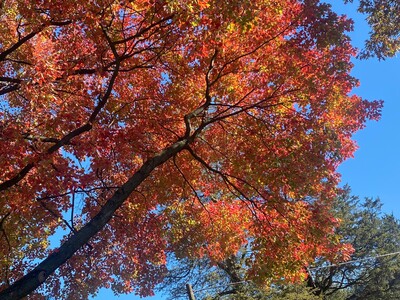


Sunny, with a high of 77 and low of 56 degrees. Sunny for the morning, clear for the afternoon and evening,