Image
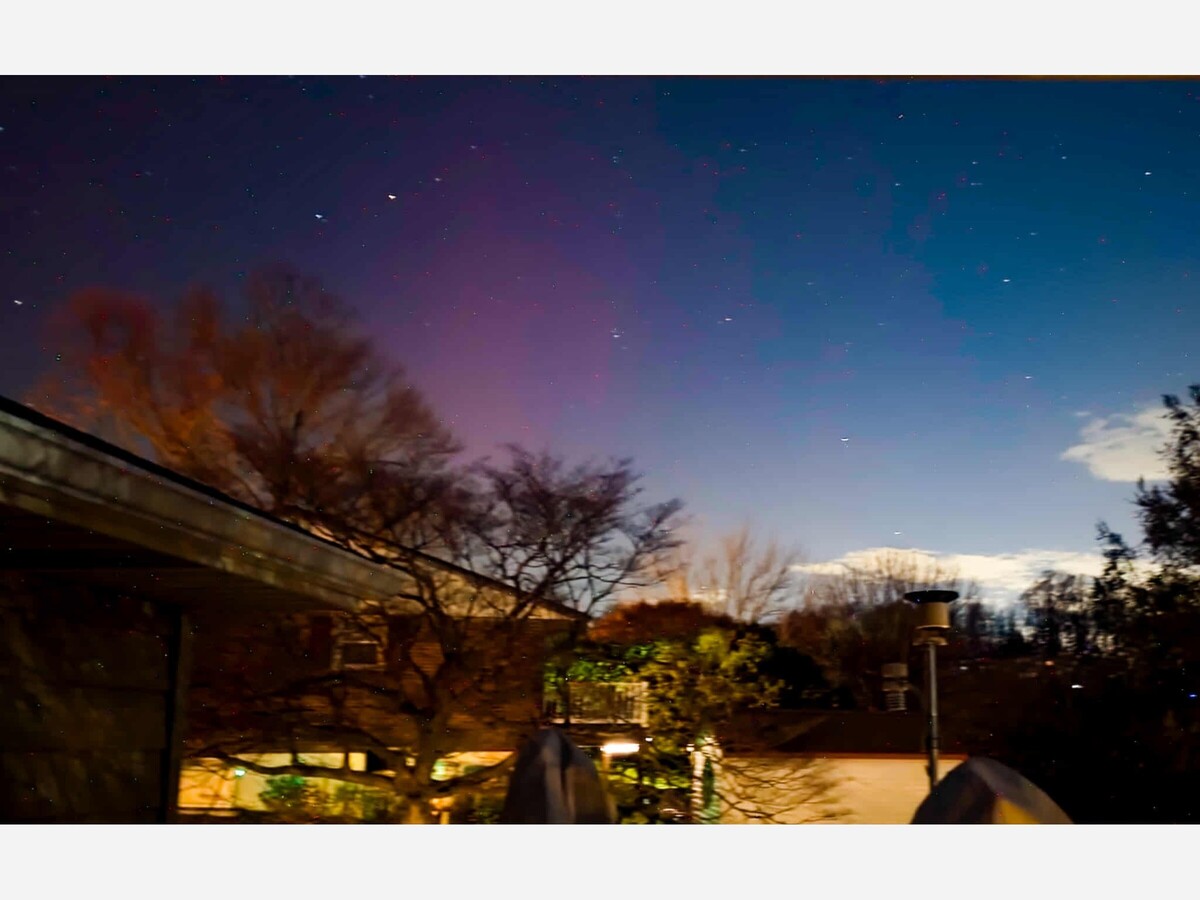
Photo by David Fisherowski.



“Seeing the Northern Lights” is an experience listed on many people’s bucket list, and recently, area residents had an opportunity to achieve that usually elusive goal.
Also known as the Aurora Borealis, the Northern Lights look like a painting of radiant colored lights created by nature and brushed across the night sky. The magnificent colored lights are mostly visible in high altitude areas around the Arctic and Antarctic.
Searching the internet provides this simple explanation of what causes the Northern Lights to appear:
“The northern lights are caused by particles from the sun colliding with gases in Earth's atmosphere, creating a colorful glow. When electrically charged particles from the sun are guided by Earth's magnetic field toward the poles, they collide with atoms and molecules like oxygen and nitrogen. These collisions excite the atoms and molecules, and as they return to their normal state, they release energy in the form of light, or photons, that we see as the aurora.”
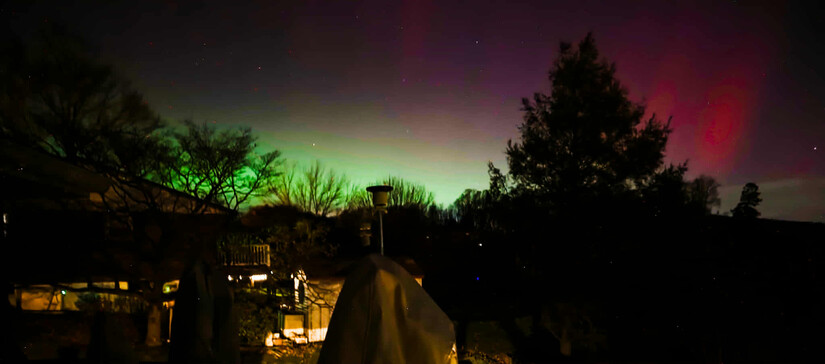 Photo by David Fisherowski.
Since the phenomenon usually is seen in the far north, most of the country is unlikely to ever see it. My own sighting happened in New York State’s Catskill Mountains. About 100 miles north of New York City, the altitude of the area ranges from 1,000 to 3,000 feet above sea level. I was ten years old and came out of dinner at a restaurant with my parents one cold November night. We were stunned into silence at the majestic show nature was providing. No telescopes or cameras were needed. Seemingly close enough to touch, were huge swaths of colors, one following the other, splashed across the overhead sky. At first, not knowing what it was and never having witnessed such a thing, I remember feeling dwarfed and a little frightened. Then it was apparent that the display was a gift from the heavens, a gift from the universe. I have never forgotten it.
More recently, scientists have predicted times when the Northern Lights would be visible further south: “due to intense solar activity from a solar maximum and the resulting severe geomagnetic storms. The increased solar activity, which peaks around 2025, sends more charged particles toward Earth. When these particles are directed by a powerful solar storm, the resulting Aurora expands beyond its typical polar range and is visible in lower latitudes.”
However, each time the experts predicted that the Lights would be visible at more southern locations, the prediction failed to come true … until November 11, 2025, when finally, conditions were right and residents could see the spectacle, if they looked through their camera lens.
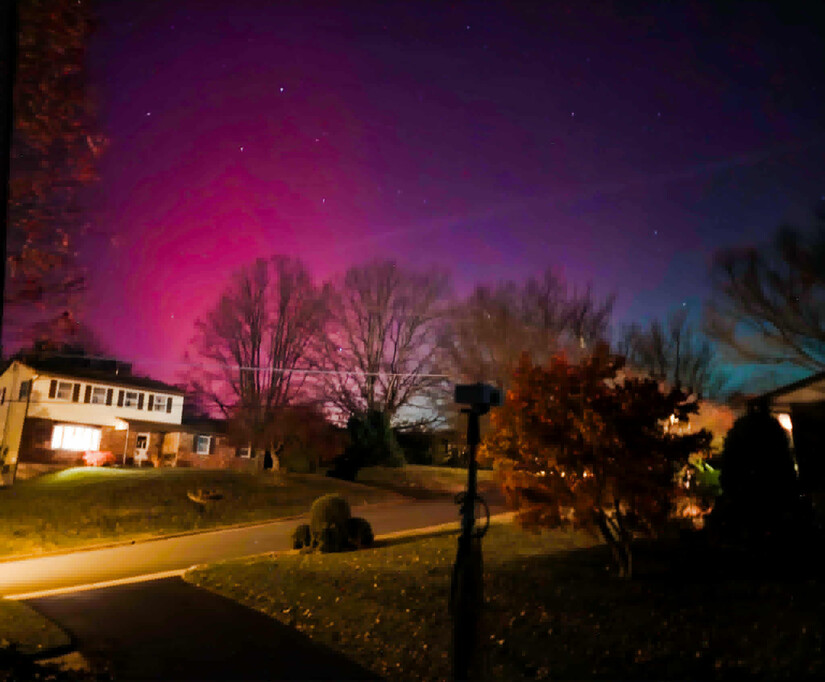 Photo by David Fisherowski.
Looking through a camera is helpful for several reasons:
“The auroras are just awe inspiring,” summarizes David Fisherowski, Boyertown retired science teacher and amateur astronomer and weather forecaster, who has graciously shared his photos for this article.
“We don't even get the best ones,” he points out. “We get horizon Auroras as shown in my photos. However, the overhead Auroras are beyond description. I've seen one of those when I lived in Erie, PA.”
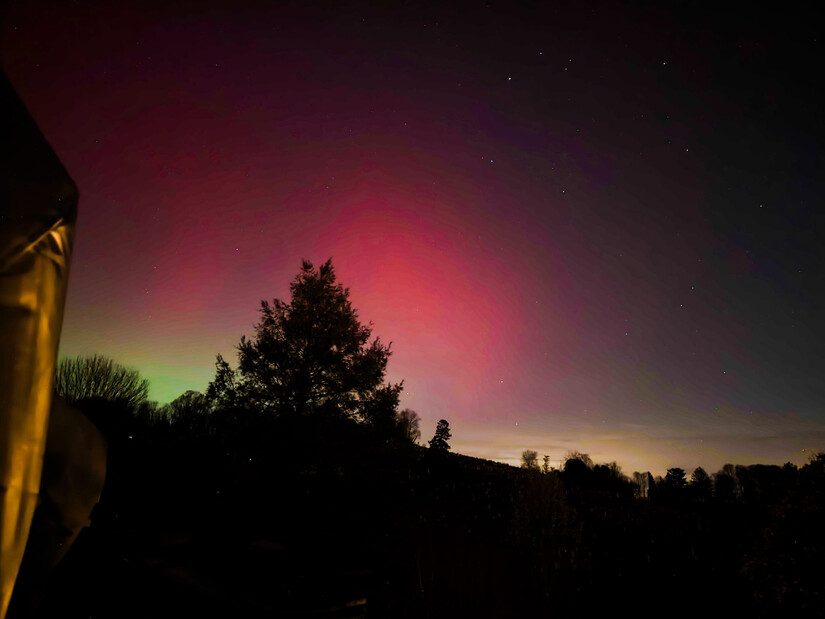 Photo by David Fisherowski.
“To understand that a huge explosion on the Sun, 93 million miles away, caused what these photos show, is just mind boggling to me, even though I, as a science person, understand the whys and wherefores. Also, to have seen two of them in the space of one year amazes me. I will never get tired of seeing them and having the technology at my fingertips to preserve that memory is amazing to me too,” Fisherowski concludes.


Sunny, with a high of 79 and low of 63 degrees. Sunny in the morning, mist overnight.



Thanks for this exposure, Jane & Leslie! Hello to everyone in Boyertown!





Dear Jan - Thank you for this article! I love the Overview Effect. planet first, society second, economy last